‘Gruesome but satisfying’- that is how one critic described the second crime novel by Conyth Little, the pen name of Australian-born sisters Jessie Constance Little (1899-1980) and Norma Gwenyth Little (1903-1985).
The title to earn such unique praise was The Black-Headed Pins, published in 1938 in the UK and US, but not reaching their native Australian shores until 1939. The novel was set at Christmas and drew on a popular set-up found in golden age detective fiction: A family comes together in a country house, tensions simmer and then erupt when one of the family is murdered. What makes this book slightly different is that the family at the centre of the novel has a strange collection of ghosts who haunt the house and can predict when a member of the family is about to have an accident.
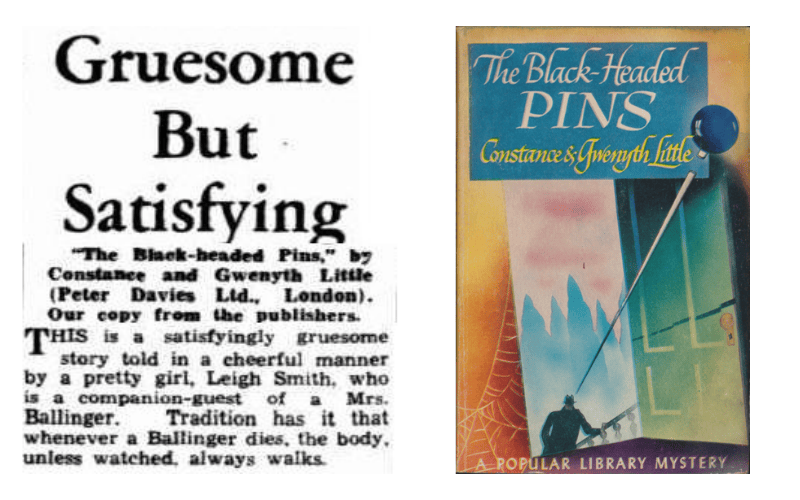
This classic crime setup with a twist was a trademark that the sisters would become synonymous with, along with the repetition of always including ‘black’ in the title of their novels. While their choice of titles seemed to irk some reviewers, the novelty and strangeness of their plot twists was always a talking point.
In 1945, when reviewing The Black Honeymoon, a critic writing under the alias Dr Watson Junior, started his review with ‘This is the first feather murder I have encountered in 25 years of devoted criminology research,’ but went on to deliver the verdict that the book, ‘has little save this diverting novelty and a certain light-heartedness to commend it.’1
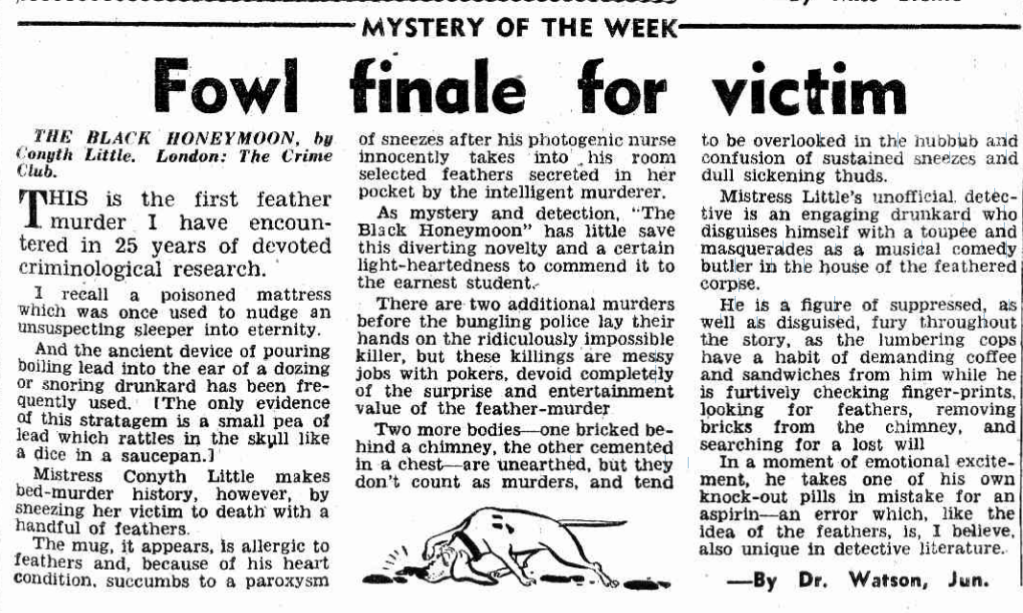
Novelty and lightheartedness are aspects to be found across many of the Conyth Little titles. The Black Thumb (1942) was described as ‘a book for those who like their murders mixed with a considerable dash of humour and gaiety.’2 While the tag line on a US edition of Great Black Kanba (also published as The Black Express) (1944) promotes the sisters as having written ‘another of their whacky mystery novels.’
Great Black Kanba was the first Conyth Little book I read, and I had been immediately drawn to its setting of a long-distance train journey across Australia. ‘Like Murder on the Orient Express’, I thought, ‘but in the Outback’. The book certainly didn’t disappoint. Here’s the blurb from the cover:
‘Who was she? Where was she going? Any why? All she knew about herself she got from a casual fellow passenger on the train. According to this dubious source, she was Miss Cleo Ballister, a pretty, shabbily dressed actress who had been struck on the head with a valise which had tumbled from an upper bunk and completely blotted her memory. Now here she was enroute to meet relatives she couldn’t remember ever having heard of before.’
As the Trans-Australian Express hurtles across vast Australian landscapes, someone aboard the train is murdered and Cleo is implicated. Essentially, it is a locked-room mystery, as the murderer had no opportunity to leave the train as it passes through the Nullarbor desert.
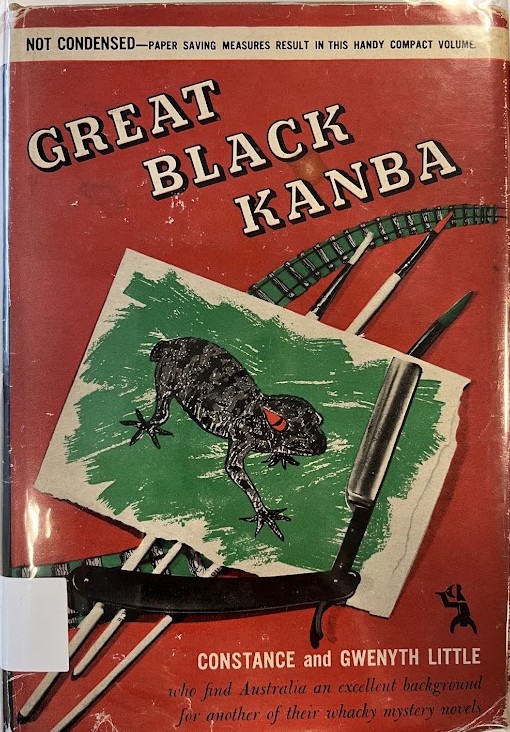
The title Great Black Kanba comes from the name that the Aboriginal people of the area called the train as it wound its way through the landscape like a large snake. The book has a cast of suspicious characters, many of whom are Cleo’s extended family who she has never met, as well as an attractive soldier-on-leave named Clive, who at first claims to be engaged to Cleo, but when she reveals to him that she has lost her memory, he tells her that she had arranged with his friend Bill for him to pose as her fiancé on the trip, for a reason unknown to him. As a doctor, Clive takes on a semi-detective role on the train when the body is discovered.
Part of the humour of the book is in the habits of Cleo’s family, who have an odd dynamic. The constant changing of trains and carriages as they cross state borders, mixing up luggage and compartments, as well as the changing of times on watches as they enter different time zones, adds to the farcical humour but also the confusion of alibis, movements, and Cleo’s muddled memory. I thought that the book was a hoot (to use a term I’m sure the characters would appreciate), and I did not pick the murderer.
Although the Little sisters published 21 crime novels (sometimes as Conyth Little and sometimes as Constance and Gwenyth Little), this is the only one set in their native Australia. The remainder are set in America, the place that the Little family emigrated to in 1911, and where the sisters each eventually married and became citizens.
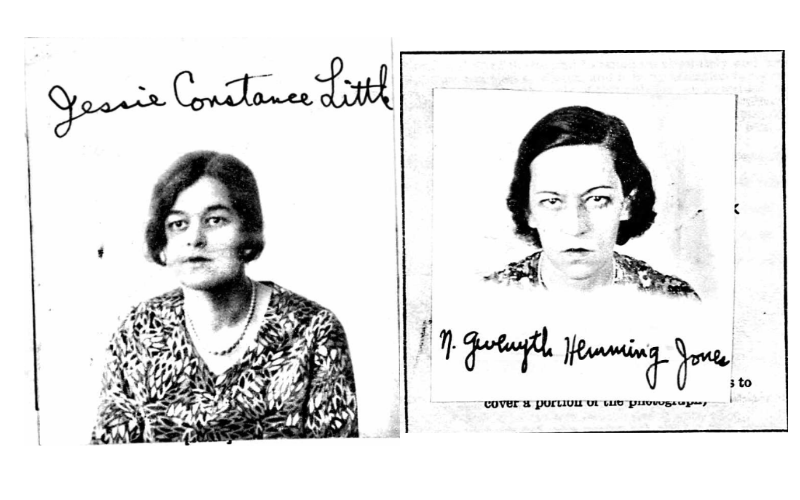
There is only a smattering of official records related to the Little family, mostly passenger arrival and departure records between the UK and the US, which showed them to be frequent travellers. The family moved from Australia to England sometime between 1906 and 1910 (although for the life of me I cannot find their passenger departure or arrival records for this journey). After England came Mexico (briefly) and then with war on the horizon, America.
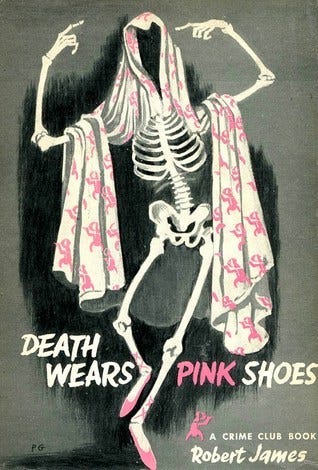
Their father was named James Fulton Little and their mother was Jessie (maiden name Gilchrist), and there were 5 children in the family, 3 girls and 2 boys. Interestingly, the youngest daughter Iris, who was born in England in 1910, also became a crime writer, publishing under the alias Robert James, which combined the names of her two brothers. Her novel, Death Wears Pink Shoes, was published in 1952 by The Crime Club and was set in New York.
Anecdotal, biographical or first-hand accounts of Constance and Gwenyth and their reasons for writing crime novels together are non-existent. They are frustratingly elusive, even for a librarian like me who spends a lot of time helping people with family history research*. The most I could find were tiny threads of information: Constance married a man named Lawrence Baker; Gwenyth married Bernard Hemming-Jones and in the 1940 US Census she described her occupation as ‘author’.
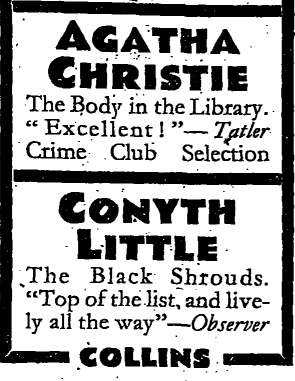
Their first book, The Grey Mist Murders, was the only one not with ‘black’ in the title, and was published in 1938. The sisters achieved moderate success in the UK and the US, with their books published by The Crime Club, that illustrious publishing arm responsible for the great Agatha Christie. In fact, when I decided to find out a little bit more about the Conyth Little books, I discovered newspaper articles and advertisements that mentioned their work alongside Agatha Christie, as well as other golden age titans such as Dorothy L Sayers and Margery Allingham.
The sisters published their last book in 1953, and like many other female authors of that period, became a little lost in obscurity. Their work was re-issued from 1999 by Rue Morgue publishing (now closed I believe), but they still remain a bit of an undiscovered gem. First edition copies of their titles are rare-ish, but can currently be purchased from rare books sellers such as Lycanthia Rare Books, or on Abebooks with prices starting at around £60. If you’d like to read some of their work without that kind of price tag, then there are a few titles available on Internet Archive, or you could try your State or National library.
Now that I’ve experienced my first taste of a ‘whacky’ Conyth Little novel, I’ll certainly be reading more, and perhaps even keeping my fingers crossed that their backlist will be picked up by a new publisher (hello British Library Publishing) so they can be introduced to new audiences.
If you’ve read a Conyth Little novel I’d be keen to hear what you thought.
*If there is anyone out there with archival papers related to the sisters, I would be very interested to hear more about them. They are a puzzle that I’d love to solve!






Leave a Reply