In 1929, Catholic priest and author of crime fiction, Ronald Knox, created a ‘Decalogue’ of ten commandments for the ideal detective story. Published in his introduction to Best Detective Stories of the Year 1928, Knox’s ‘rules’ introduced the concept of ‘fair play’ in detective fiction, in which the reader must be given all the necessary clues to help them solve the mystery for themselves. Knox intended his ten commandments to be ‘tongue-in-cheek,’1 but somehow along the way these rules were taken seriously, and if a writer of detective fiction ever broke (or bent) one of the rules, critics would accuse them of not playing fair with their readers.
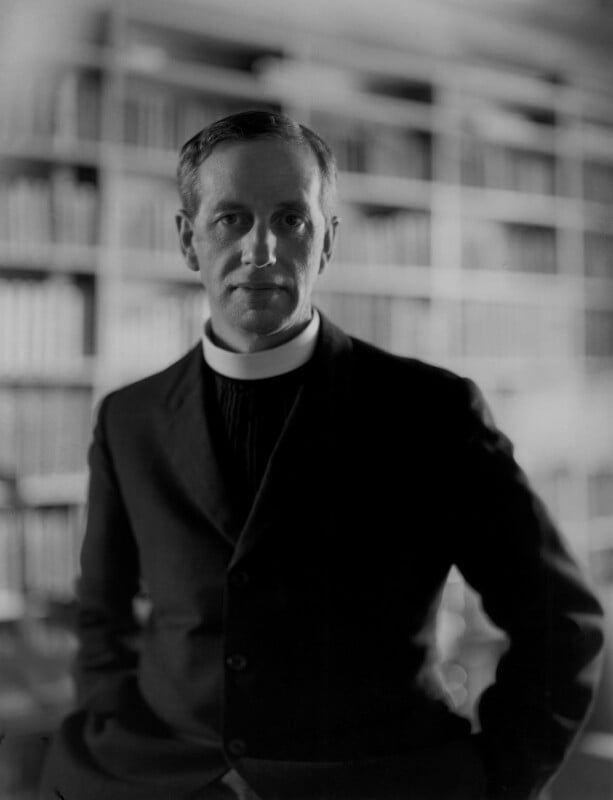
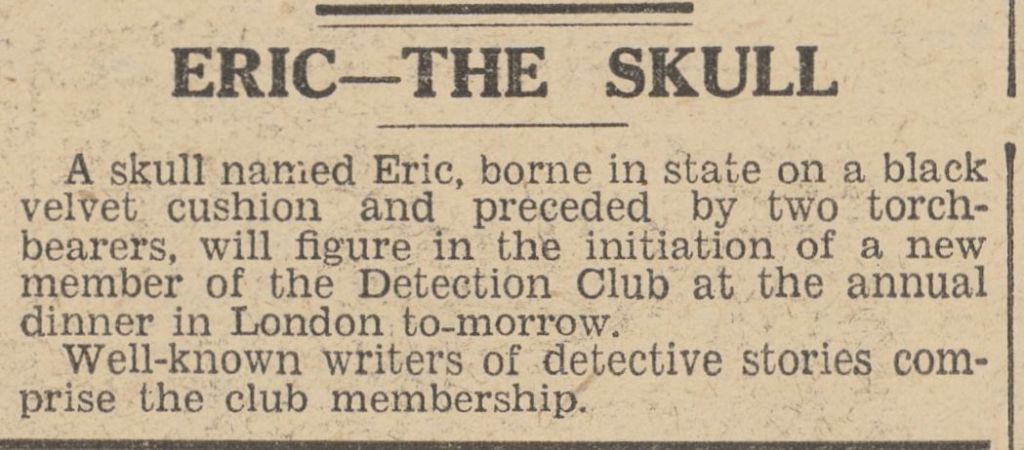
Rule number 2 of Knox’s ‘Decalogue’ centered around the use of supernatural devices. It stated: ‘All supernatural and preternatural agencies are ruled out as a matter of course.’2 A year after Knox published his ‘rules’, crime writers Anthony Berkeley and Dorothy L Sayers formed the Detection Club, and within a few years, the club’s initiation ritual (which was also tongue-in-cheek) incorporated Knox’s rules into their oath. New members had to swear on a skull (named Eric) that the solution to their detective stories would not rely on ‘Mumbo-Jumbo’ and ‘Jiggery-Pokery’. Ghosts were also only to be used in ‘seemly moderation.’3
Agatha Christie wasn’t averse to using ghosts, poltergeists, divine intervention, mediums, séances and the supernatural across her works. Her short story collection, The Hound of Death, published in 1933, includes twelve stories that draw on the uncanny. In ‘The Red Signal’, a young man has a sixth-sense that he is in danger if he returns home, and is proven correct, and in ‘The Lamp’, a family take on a house haunted by the ghost of an abandoned child.
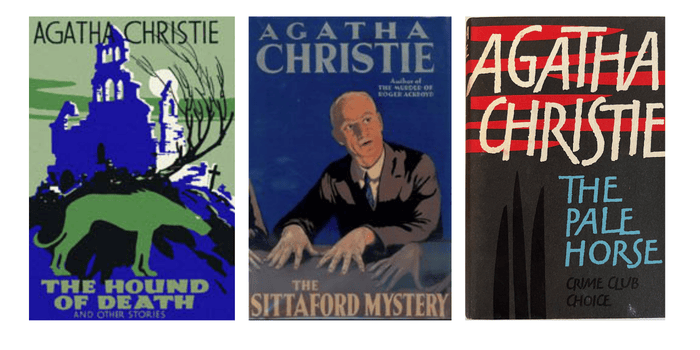
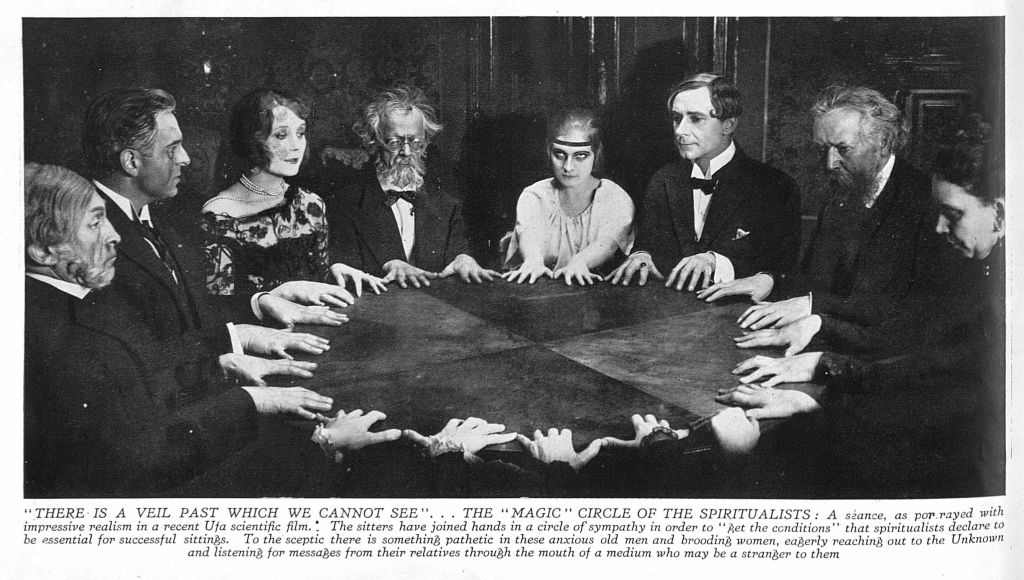
In her full-length novels, Peril at End House (1932) includes a séance at the end of the novel. This positioning acts to draw the murderer out and reveal their motives through the trope of gathering all the suspects in the room for Poirot to make his big reveal. In contrast, The Sittaford Mystery (1931) begins with a séance as a method to introduce the characters and set the tension, as the séance reveals that Captain Trevelyan is dead, he’s been murdered seemingly while they have all been holding their séance in a house cut off by deep snow. Agatha’s most well-known novel of the uncanny is The Pale Horse, which works on the suggestion that a group of so-called witches can be hired to murder by using curses and voodoo.
In almost all Agatha’s supernatural-themed stories, she sticks to Knox’s ‘rules’ by presenting a solution that has a logical explanation for the otherworldly events. Mediums and spiritualists are often shown to be charlatans and tricksters, and the people who believe or buy-in to the drama of the séance become a source of ridicule among the other characters. We see this in the description of the Tripp sisters in Dumb Witness (1937), who are portrayed as eccentric, scatter-brained gossips. Captain Hastings derides them as being ‘vegetarians’ and ‘spiritualists’, and asks Poirot if it is possible to learn anything of interest from the ‘fandango of nonsense we’ve just been listening to’.4
Agatha’s sixth sense
What level of belief Agatha had in the supernatural is hard to judge. She was religious, so perhaps had some belief in divine intervention, but the ‘jiggery-pokery’ was probably more of an interest so that she could accurately write séances and the like into her fiction. In the 1920s and 30s, spiritualism and séances were hugely popular forms of entertainment at dinner parties by staunch believers, as well as those who saw it as a bit of fun.
And yet, there were times in Agatha’s personal life when the uncanny can be found.
The first of these was through Agatha’s mother, Clara, who was said to have psychic abilities. In her autobiography, Agatha writes that her mother had ‘curious flashes of intuition- of knowing suddenly what other people were thinking.’5 She goes on to describe an instance when over dinner Clara correctly called out Agatha’s wayward brother Monty for having recently been to the moneylenders- a secret he had not divulged to anyone. Agatha’s older sister Madge also believed in Clara’s psychic abilities, telling Agatha once: ‘Anything I don’t want mother to know, I don’t even think of if she’s in the room.’6
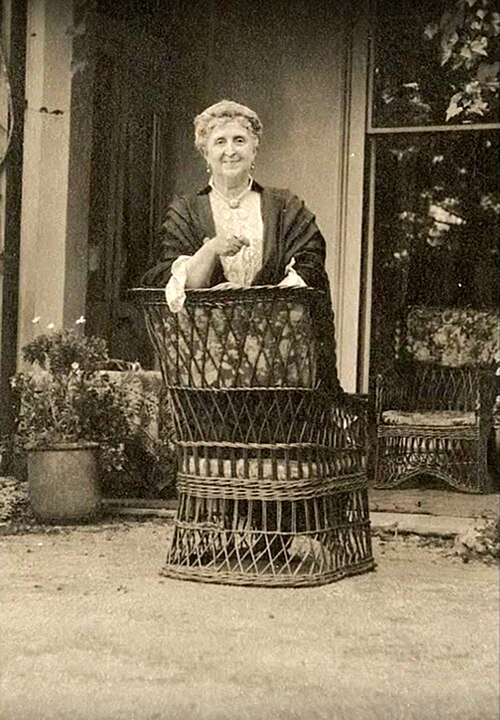
This ‘intuition’ was clearly passed down to Agatha, as when her mother died in 1926, Agatha knew the moment her mother died before being told. Max Mallowan recounts the moment in his own memoir, saying that Agatha was on the train on her way to Abney Hall to see her sick mother when: ‘the certainty came upon her that her mother was dead; a desolate feeling of utter cold, and on checking her watch she discovered afterwards that this was indeed the hour at which her mother’s end came.’7 In her autobiography, Agatha described it as: ‘I felt a coldness, as though I was invaded all over, from head to feet, with some deadly chill- and I thought: “Mother is dead.”’8
The foreboding dread was something that she experienced again when her daughter Rosalind was about to give birth to her first (and only) child in 1943. On this occasion, Agatha’s anxiety stemmed from the fact that Rosalind’s ‘lifeline’ was broken in both hands9. This was a reference to palmistry, an ancient practice which believes that a person’s future can be predicted by ‘reading’ the lines on their hands. For non-believers, it would undoubtedly fall into the category of ‘Mumbo-jumbo’. But perhaps there was something in Agatha’s anxiety, as a year later, Rosalind’s husband Major Hubert Prichard died while on active service, thereby altering her life course and leaving her a widow.
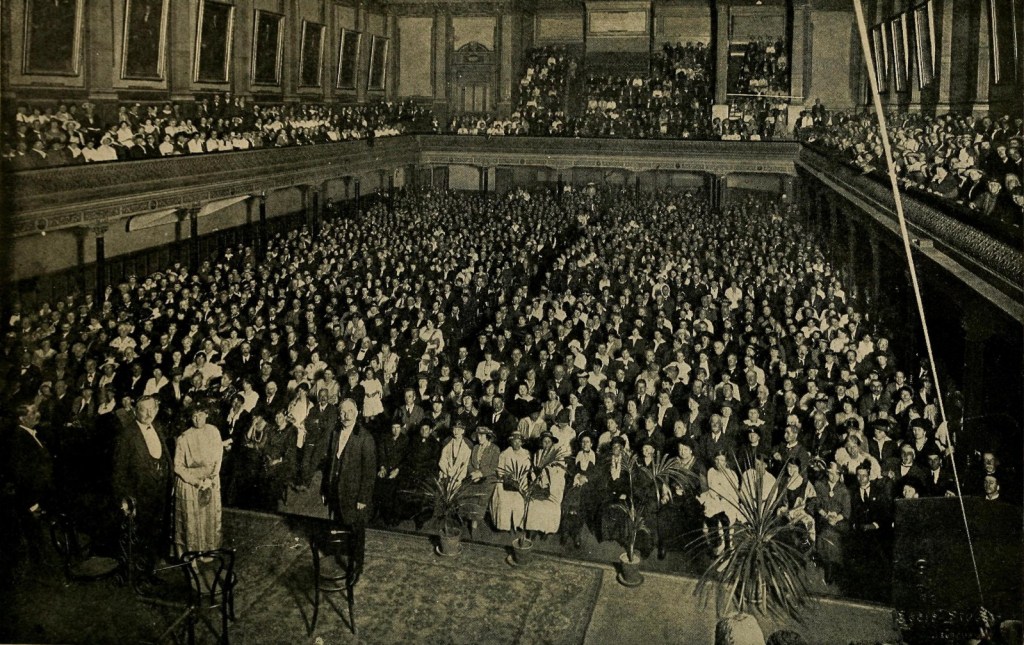
In these memories, Agatha never associates her intuition as being due to psychic ability or a sixth-sense, they are simply ‘feelings’ that can’t logically be explained. She wasn’t the type of ardent believer of the supernatural that an author like Sir Arthur Conan Doyle was. He was such a staunch believer of spiritualism that he toured Australia in 1920, giving lectures of his experiences speaking to the dead, in the hope of converting others to his beliefs.
Hunted by spiritualists
Agatha Christie and the world of spiritualism collided spectacularly in 1926 when all of Britain was feverishly searching for her when she went missing for eleven days. Believing that the spirit world could help locate Agatha, Sir Arthur Conan Doyle took one of Agatha’s gloves to a spiritualist named Horace Leaf, who said that Agatha was still alive and would soon be found10. This may have been heartening news for her family, as other reports were more certain that she was dead. Another medium contacted the police to say that Agatha’s body would be found in a pool of blood, and Agatha’s husband Archie reportedly received multiple phone calls at his home from mediums and spiritualists offering to hold séances to locate Agatha’s body.
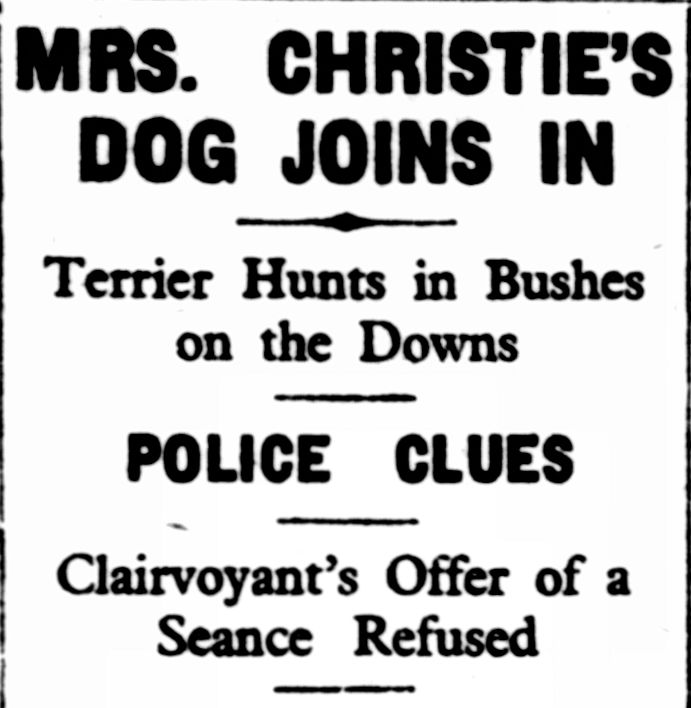
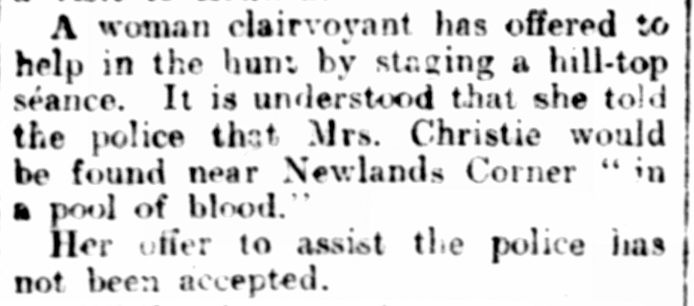
It is perhaps a little uncanny that Conan Doyle’s spiritualist was only one day off when he predicted what date Agatha would be found, or perhaps it was just a lucky coincidence. For Agatha, I imagine the knowledge that people had employed spiritualists and mediums to locate her, was a source of mortification, but it is also interesting to consider that it was in the years immediately after her disappearance that she wrote many of her supernatural tales. Can we read something in to this? Maybe. Or maybe she was just writing about a topic that was hugely popular at the time. Either way, Agatha’s tales of the supernatural and uncanny are some of my favourites- I clearly don’t mind a bit of ‘mumbo-jumbo’ and ‘jiggery-pokery’ in my detective stories!
References
- Edwards, M (2015) The Golden Age of Murder: the mystery of the writers who invented the modern detective story, Harper Collins, London, p 118 ↩︎
- Morris, D (2024) ‘ANTHOLOGY: Best English Detective Stories – 1928 (the first Miss Marple story)’, Collecting Christie [website], accessed 30 August 2026. https://www.collectingchristie.com/post/collecting-the-first-miss-marple-story-in-a-book ↩︎
- Edwards, M (2015) The Golden Age of Murder: the mystery of the writers who invented the modern detective story, Harper Collins, London, p 119 ↩︎
- Christie, A (2012) Dumb Witness, Harper Collins, London, p 104 ↩︎
- Christie, A (1977) An Autobiography, Williams Collins Sons & Co, London, p 21 ↩︎
- Christie, A (1977) An Autobiography, Williams Collins Sons & Co, London, p 21 ↩︎
- Mallowan, M.E.L. (1977) Mallowan’s Memoirs, Collins, London, p 200. ↩︎
- Christie, A (1977) An Autobiography, Williams Collins Sons & Co, London, p 346 ↩︎
- Morgan, J (1984) Agatha Christie: a biography, Collins, London, p 243 ↩︎
- de Garmont, N (2022)The secrets of Agatha Christie’s mysterious disappearance. Pan Macmillan [website], accessed 31 August 2026. https://www.panmacmillan.com/blogs/crime-thriller/secrets-of-agatha-christie-disappearance ↩︎




Leave a comment