

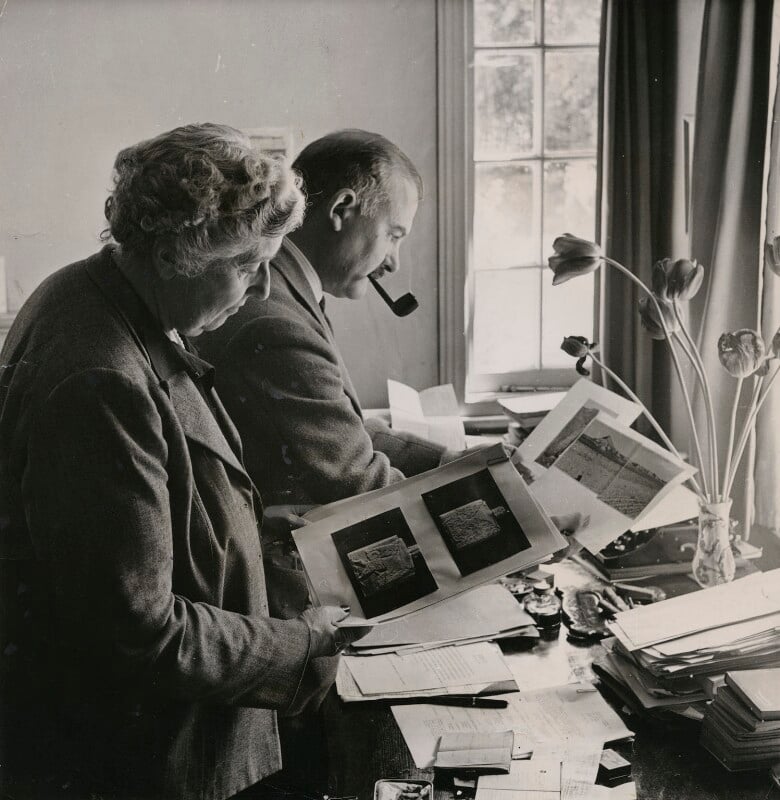
Left: Agatha Christie, National Portrait Gallery, London. NPG x82104. Right: First edition cover.
In 1950 Agatha Christie reached an important milestone in her literary career with the publication of her 50th book, A Murder is Announced. Often cited as a fan favourite, this Miss Marple whodunnit is set in the fictional village of Chipping Cleghorn, and has all the ingredients for a classic Christie mystery- a small village setting, an enclosed circle of gossipy busybodies, and an exciting premise. In her element is Christie’s spinster sleuth Miss Marple, the sharp-eyed and intelligent amateur detective that Christie came to favour over her more eccentric creation, Hercule Poirot.
The story begins with an advertisement placed in the classifieds of the local newspaper, the Chipping Cleghorn Gazette. It reads:
‘A murder is announced and will take place on Friday 29th October, at Little Paddocks, at 6:30pm. Friends please accept this, the only intimation.’
The invitation is a stroke of genius as a set up for the story. In the world of Miss Marple’s English village, what person could resist such an intriguing advertisement? The group of potential suspects and victims all assemble, anticipating one of those popular ‘murder games’, and then the lights go out. Agatha’s notebooks show that she began plotting the book in 1947, with the newspaper advertisement playing a central role in how she teased out the characters and potential culprits1.

Left: The Evening News, 27 February 1950. Right: The Herald, 15 June 1950.
For an important anniversary title in Agatha’s career, the premise was also a stroke of marketing genius as newspapers could advertise the book by copying the notice in the Chipping Cleghorn Gazette. It wasn’t the first time that Agatha had used a newspaper advertisement as a catapult to her plot, and therefore not the first time that newspapers had run advertisements in the style of the one featured in the book. The earliest example of this is for The Secret Adversary, published in 1922.
The game of murder
The characters who respond to the advertisement in the Chipping Cleghorn Gazette and assemble at Little Paddocks all believe that Letitia Blacklock, the mistress of the house, is hosting a murder game. One of the villagers, Edmund, describes the game like this to his mother over breakfast:
‘Somebody’s the victim and somebody else is a detective- and then they turn the lights out and someone taps you on the shoulder and then you scream and lie down and sham dead.’2
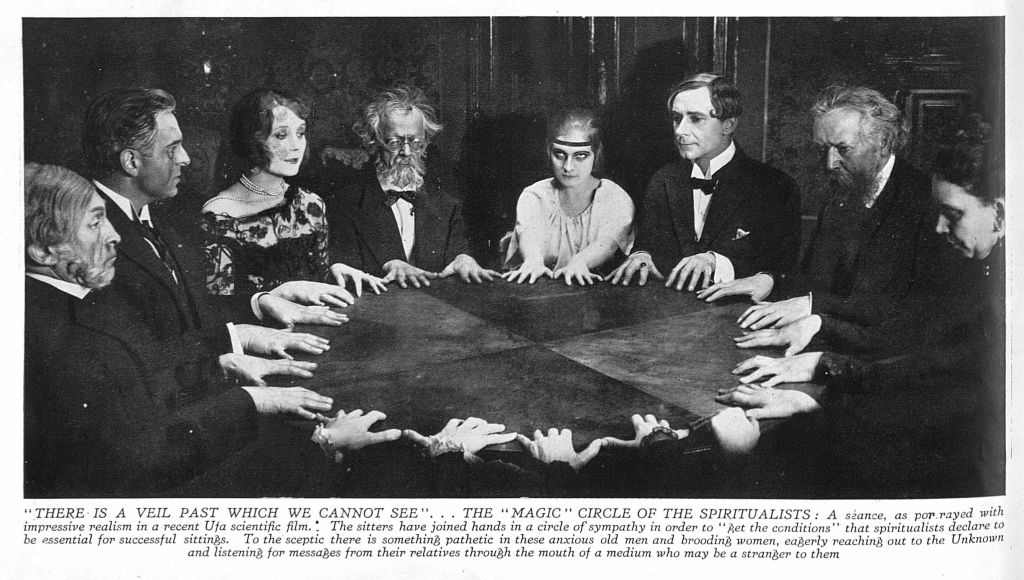
This parlour game, sometimes called ‘murder in the dark’, ‘wink murder’ (if the victim is winked at rather than tapped on the shoulder in the dark), or just ‘Murder’, was popular in the 1930s, with many newspapers suggesting that the game was ideal for dinner parties. How to play the game varied. Sometimes participants would pick cards from a deck, with whoever getting the ace of spades designated as the murderer.

Another option was to draw papers from a hat to decide roles- blank papers meant you were a potential victim, while ‘M’ designated you the murderer. This version became the most popular, and was described by Edmund to his mother in Agatha’s version. The game was also used as the premise for the little-known detective novel It Means Mischief (also called Death by Domino) by Roland Pertwee, which was serialised in English newspapers in 1931, no doubt introducing the game to a wider audience.
The game became the ‘it’ thing at parties hosted by all classes of society, right up to Dukes and Duchesses. Its popularity continued into World War II, when Brits needed something fun to do to pass the long hours of blackout restrictions at night.3 This fun and easy game was also the inspiration for the development of the board game ‘Cluedo’ (originally called ‘Murder’).

It was during the blackout restrictions and bombings of Birmingham in 1943 that machine tool fitter Anthony Pratt and his wife Eva developed the concept for the board game4. The patent for the idea was applied for in 1944 and confirmed in 19475, with the first version of the game sold in 1949.
The Queen of Crime
A Murder is Announced was promoted as Agatha’s ‘jubilee’ and the cover of the book crowned her as the ‘Queen of Detection’. This acknowledgement, that Agatha was the leading author of the genre, was gifted to her quite early in her career. ‘Mistress of Mystery’, ‘Duchess of Death’, and ‘Queen of Detection’, were all used interchangeably at various times by publishers, newspapers and critics. Eventually, the name ‘Queen of Crime’ was settled on, and Agatha’s family took steps in 2013 to trademark the title.

Left: The Illustrated London News, 10 June 1950. Right: Bundaberg News Mail, 12 August 1950.
Of her jubilee title, a reviewer for The London Illustrated News, was less than complimentary when it came to the believability of the plot, but nevertheless went on to say that he ‘would rather have a poor Christie than almost anything her rivals can do. She is not a, but the detective novelist: a species apart.’6
To celebrate the milestone, Agatha’s publishers arranged for a special party to be held at The Ritz in London, one of Agatha’s favourite hotels. 120 guests, including many fellow writers such as Ngaio Marsh, attended the party, drinking cocktails and enjoying a cake decorated with a sketch of Hercule Poirot drawn in chocolate icing7. This seems a rather strange choice given A Murder is Announced is a Miss Marple story, and Agatha had always been against depictions of Poirot on the covers of her books- clearly Poirot in icing was acceptable!
Delicious Death
One of the main themes of A Murder is Announced is food- wartime rations, black market purchases, and a very special birthday cake named ‘Delicious Death’. Agatha dedicated the book to her friends Ralph and Anne Newman, with the note of ‘at whose house I first tasted ‘Delicious Death’. The cake is a specialty of Mitzi’s, the foreign maid working at Little Paddocks, who agrees to make the cake (despite post-war rations) as a special treat for Dora’s birthday. Her list of ingredients for the cake include chocolate, butter, sugar and raisins- all of which Miss Blacklock manages to secure for her by black market methods, or by dipping into their stocks reserved for Christmas.

In 2010, to celebrate the 120th anniversary of Agatha’s birth, Jane Asher was commissioned to create a complete recipe for the cake using the sparse details written by Agatha in the book. Asher is an English actress who appeared in the 2004 Miss Marple TV adaptation of Murder at the Vicarage, as well as the 2010 TV adaptation of Poirot’s Three Act Tragedy. In the UK, Asher is equally well-known for her cake making business and baking books.

Her interpretation of the recipe is not entirely in keeping with the book, but instead brings it into modernity, offering an indulgent chocolate treat that would give modern readers the same sense of decadence that the ration-restricted characters of the book would have felt with their more simple cake. It would have been an interesting task to compare the recipe that Agatha knew and imagined in her book, with Asher’s recipe. One thing for certain is that Agatha would have approved of the large amount of cream in the icing of Asher’s cake. Agatha was quite a fan of cream, and apparently used to drink it out of a cup with ‘Don’t be greedy’ written on the side.8

In honour of my own reading of A Murder is Announced for My Year with Agatha, I decided to make my own version of ‘Delicious Death’. It’s not as indulgent as Asher’s, and instead leans more towards how I imagined Mitzi’s cake to be when I first read the book as a teenager. The simpler cake also meant that I could add a side of cream- something I think Agatha would have strongly approved of!
References
- Curran, J (2009) Agatha Christie’s secret notebooks : fifty years of mysteries in the making, Harper Collins, London, p 175 ↩︎
- Christie, A (2006) A Murder is Announced, Harper Collins, London, p 13 ↩︎
- Mills, R., Bernthal, J.C. (2020) Agatha Christie Goes to War, Taylor & Francis, New York, p 161 ↩︎
- Fallas, R. (2016) Waddington’s Cluedo and how ‘The Great Detective Game’ was made in Leeds, Leeds Museums and Galleries website, accessed 25 July 2026 ↩︎
- ‘Improvements in board games’ patent application by Anthony E Pratt, patent 586,817, European Patent Office, accessed 25 July 2026 ↩︎
- The London Illustrated News, 24 June 1950 ↩︎
- Edinburgh Evening News, 10 June 1950 ↩︎
- Dean, S (2012), Agatha Christie’s favourite food was cream, Bon Appetit (website), accessed 30 July 2026 ↩︎






Leave a Reply