In the 1930s Agatha Christie entered a golden age of productivity, producing nineteen full-length novels, two of which were published under the pseudonym Mary Westmacott. If that wasn’t impressive enough, she also found time to complete six short story collections, two plays, and contribute to three publications written by members of The Detection Club. No other period of her career would be so prolific, and it was during this decade of social upheaval in England and anxieties about aggressions in Europe, that Agatha forged a notoriety as a leading author of detective stories.
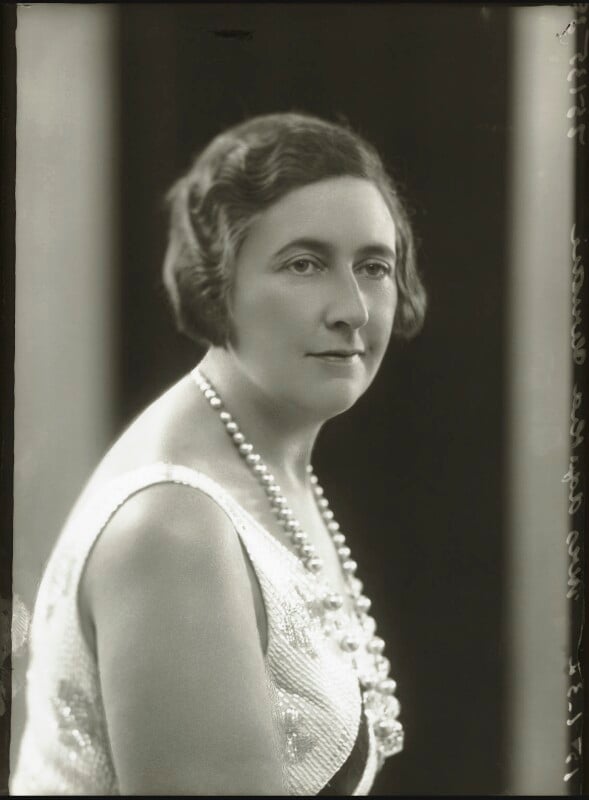
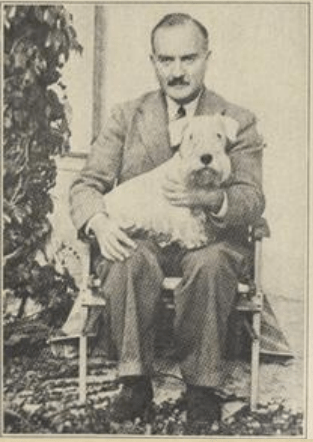
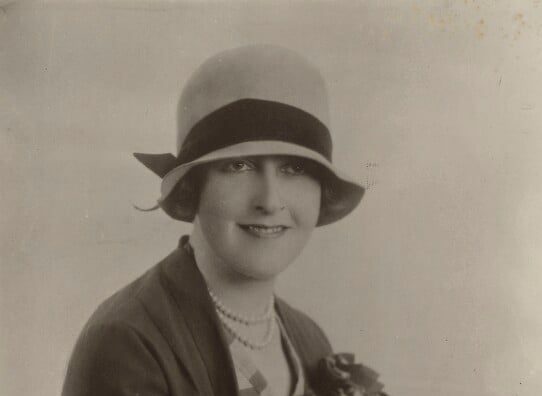
Left: Portrait of Agatha Christie by Bassano Ltd, 15 January 1932. National Portrait Gallery. Right: Max Mallowan, The Australian Women’s Weekly, 18 January 1978.
Money matters
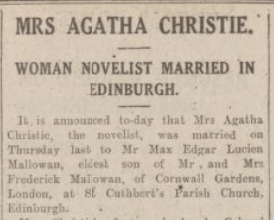
There are likely a few reasons why the 1930s proved so fruitful for Agatha. Her marriage to the archaeologist Max Mallowan at St Cuthbert’s Church in Edinburgh in September 1930, was to herald a new beginning for Agatha’s personal life, and a happy marriage that would last for the rest of her life. Her travels on the Orient Express and to Baghdad at the end of the previous decade, the trip on which she met Max, undoubtedly put some spark back into Agatha after the bruising ordeal of her divorce from Archie. She came home from that journey with a new love, and a belief that she could make a living for herself as a serious writer. This belief didn’t stem from ego, but from a necessity. Money.
In her autobiography, Agatha talks candidly about the effect that the need to make money had on her writing, saying that if she knew she had a bill to pay, she would calculate whether a short story or a novel would pay that bill, and would then sit down and write1. For fans of Agatha Christie, this might come as a bit of a shock, removing some of the excitement of the detective stories, and reducing them to something merely transactional. But Agatha also acquired a rather expensive hobby in the 1930s which required a close handle on her finances- buying and selling property.
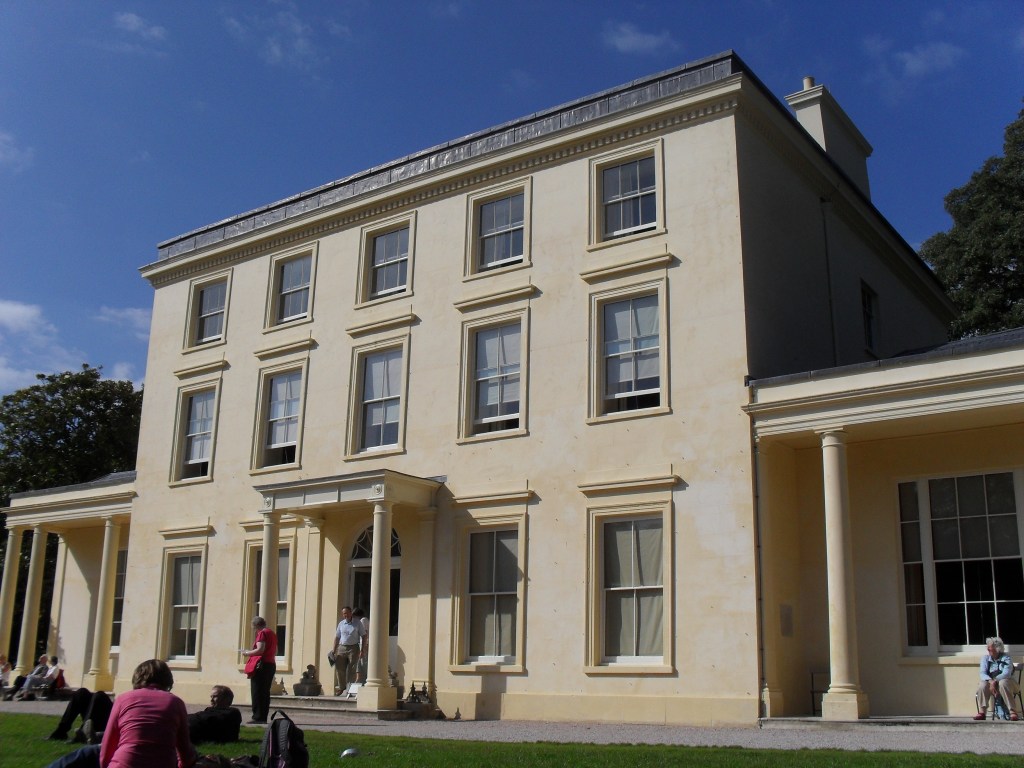
It was during this decade that Agatha acquired her most well known properties- Winterbrook House in Oxfordshire, which she bought in 1934, and Greenway House in Devon, bought in 1938, and now owned by The National Trust. Agatha described Greenway as ‘the ideal house, a dream house2‘. For a deep dive into Agatha’s property portfolio during this period, I highly recommend the podcast Shedunnit who produced a fantastic episode on Agatha the property tycoon.
That Agatha could develop an extensive property portfolio during this period is at odds with the mood in England. The Great Depression had caused mass unemployment in the early 1930s, reaching a peak of nearly three million, and plunging many people into poverty. This was a stark contrast to the carefree frivolity of the previous decade which had garnered the nickname ‘the Roaring Twenties’. It’s a testament to how well Agatha was doing as a writer, that as her popularity grew, the amount of money she could command for her work also grew. Agatha could charge more than £3000 pounds for a serialisation of one of her novels in America3.
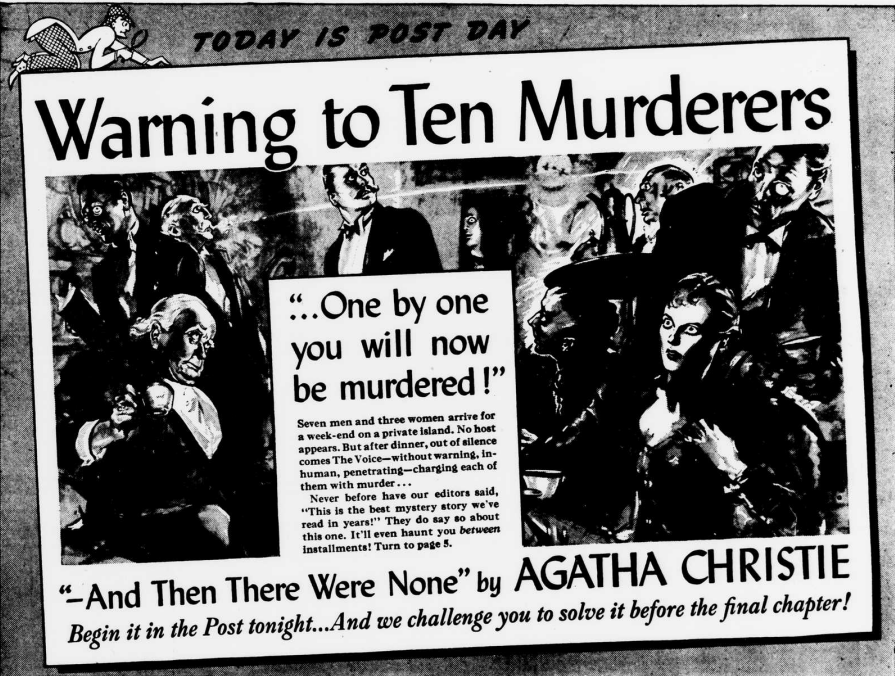
While Agatha produced some of her most popular novels during this decade, such as Murder on the Orient Express (1934) and Death on the Nile (1937), it is through her short stories that I think we see her versatility and creativity. Her six short story collections encompass over fifty stories, and feature a variety of iconic sub-characters- Parker Pyne, Ariadne Oliver, Miss Lemon- in domestic and exotic locations, from Cornwall to Baghdad.
Murder clubs
In 1932 we see the appearance of Miss Marple, Christie’s spinster sleuth, in The Thirteen Problems, a collection of stories that had first appeared in magazines from 1927. The collection is tied together by the overarching premise that a group of people get together to relate tales of mysteries which the other guests must try and solve. Many theories are thrown around, but Miss Marple invariably comes out on top. In later years, Agatha would name this collection as one of her favourites, choosing it to be one of the collection of ten Penguin reprints handpicked by her in 1953.
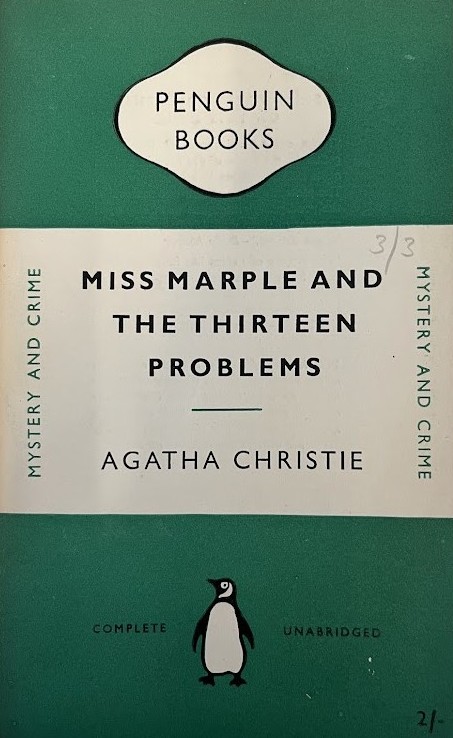
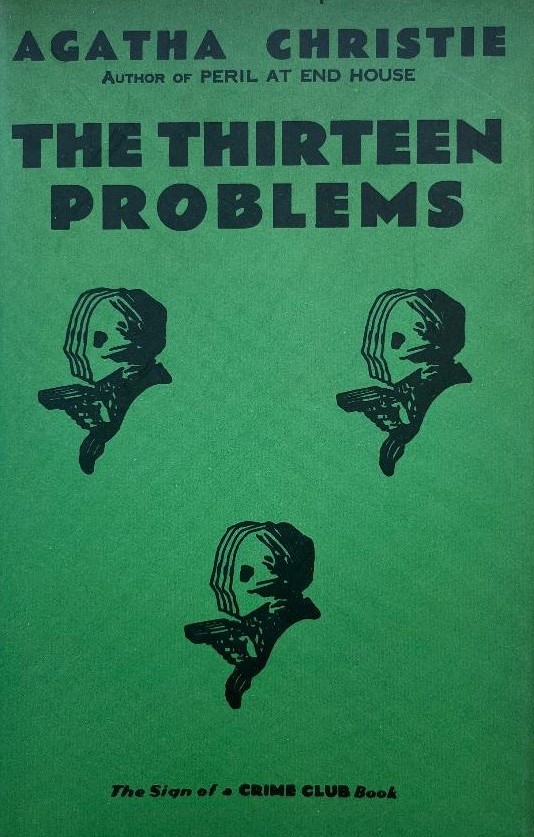
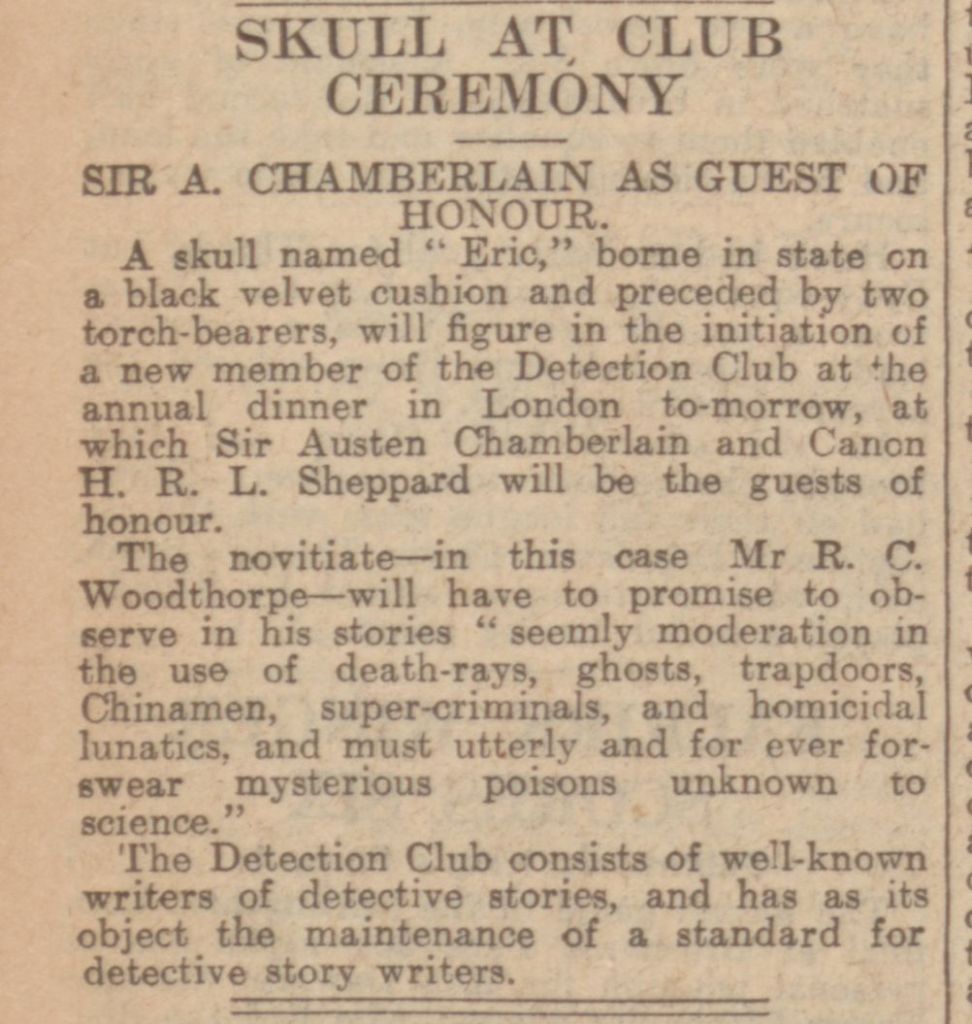
The format of Agatha’s fictional ‘Tuesday Night Club’ in which a group of amateur detectives meet to discuss crime, mirrors Agatha’s own membership of The Detection Club, which formed in 1930. Started by fellow crime writers Anthony Berkeley (author of The Poisoned Chocolates Case), and Dorothy L Sayers (creator of Lord Peter Wimsey), the group met at their headquarters on Gerrard Street in London’s Soho district, to discuss criminology, police procedure, and true-crime cases, over dinner. The group invited other worthy crime writers to join them and were known to require new members to swear a tongue-in-cheek oath on the skull of Eric, the club mascot, to follow certain rules of crime writing. These ‘rules’ followed the idea of fair play, in which readers had to be given all the necessary clues to identify ‘whodunnit’. It expressed a formulaic list of ingredients needed for the perfect work of detective fiction.
The Detection Club was inspired by another group called the Crimes Club, which began around 1903, and which still runs today under the name Our Society. The group in its first iteration was made up on coroners, barristers, journalists, and academics, and included big names in its membership, such as Sir Arthur Conan Doyle (creator of Sherlock Holmes) and Samuel Ingleby Oddie (the London coroner who conducted over 30,000 inquests during his career). This group would discuss real-life crimes, and debate the evidence presented in newspapers and other records. In their early days, the group was quite interested in the case of Jack the Ripper. In 1905, Ingleby Oddie went so far as to organize a walking tour of the murder sites for some members of the club, including Arthur Conan Doyle, with the police surgeon in charge of the district at the time of the murders.
Inspiration
With a happy marriage, a collection of idyllic homes, and a social circle of like-minded writers, things were definitely on the up for Agatha. It is interesting then to consider how Agatha was able to come up with so many characters and plots for her stories. Aspiring crime writers might like to try some of Agatha’s tried and tested ways of plotting a complicated whodunnit.
In the forward that she wrote to the 1953 Penguin printing of The Labours of Hercules, Agatha said that, ‘the really safe and satisfactory place to work out a story in your mind is when you are washing up.’4 One of the things I like most about this advice is that it places Agatha is a realm of domesticity, although I do find it difficult to imagine Agatha standing in the kitchen at Greenway House with suds up to her elbows, as she puzzles over her plots! According to Agatha, she also found riding an escalator conducive to plotting. She wrote, ‘and then, suddenly, one day, coming up on the escalator of the Tube, the idea came. Thinking excitedly about it, I went up and down the escalator about eight times and was then nearly run over by a bus on the way home!’5 Her ingenious plots clearly came with some unusual bursts of inspiration, but her husband Max Mallowan would later say that her success was due to her ‘permanent condition of fantasy.’6
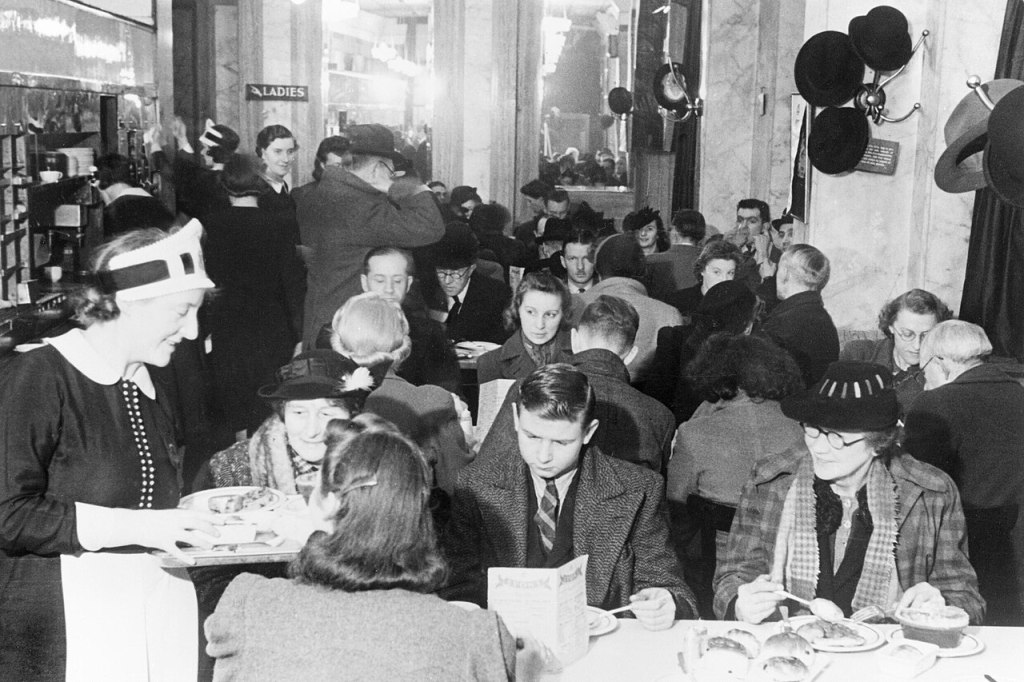
Imperial War Museums, D 6573.
Other ways of finding inspiration were through people watching and, in the true style of Miss Marple, eavesdropping. The idea for the character Parker Pyne, came to Agatha when she spotted a man with a bald head and glasses having lunch at Corner House in London. He was enthusiastically discussing statistics with his lunch companion. This simple interaction inspired a series of short stories, published as Parker Pyne Investigates in 1934. One of Agatha’s favourite stories in this collection was The Case of the Rich Woman, which was based on an interaction Agatha had with a stranger as she looked at a shop window. Agatha relates it like this:
She said with the utmost venom: ‘I’d like to know what I can do with all the money I’ve got. I’m too seasick for a yacht- I’ve got a couple of cars and three fur coats- and too much rich food fair turns my stomach.’ Startled, I murmured ‘Hospitals?’. She snorted ‘Hospitals? I don’t do charity. I want to get my money’s worth’ and departed wrathfully.7
Even with a fertile imagination, real life would always provide Agatha with what she needed to get started on a new story. True crime reported in newspapers was always a good place to start. Agatha also became an avid reader of the series Famous Trials, which she used as research for turning her short story Witness for the Prosecution into a play.8 Agatha also took the time to ensure her work was authentic, researching poisons, antidotes, and medical matters so that she could ensure she had her facts right. She also consulted professionals to understand police practices, the law, and court proceedings.9 Clearly a lot of work went into her novels which have so often been disregarded as ‘cosy crime’ by non-fans.
The beginning of the Second World War in 1939 closed a chapter on Agatha’s most prolific writing decade. As Britain went to war, she would continue to write, mostly to distract herself from the war, but from 1945, she would settle into a steadier one-book-per-year pace which she maintained for the rest of her life. For Agatha fans, the books of the 1930s provide ample titles, characters and plots to enjoy. My personal favourite is Death on the Nile, a gripping tale of romance turned sour, and one which I’ll be investigating in more depth in my next ‘My year with Agatha’ installment.
Catch up on the ‘My year with Agatha‘ series here.
References
- Christie, A (2010), An Autobiography, Harper Collins, London, p 413 ↩︎
- Christie, A (2010), An Autobiography, Harper Collins, London, p 480 ↩︎
- Daily Express, 3 June 1939 ↩︎
- Christie, A (1953), The labours of Hercules, Penguin, London, p 4. ↩︎
- as above ↩︎
- Mallowan, M (1977), Mallowan’s memoirs, Collins, London, p 204. ↩︎
- Christie, A (1953), Parker Pyne Investigates, Penguin, London, p 8. ↩︎
- Saunders, P (1972), The Mousetrap man; with an introduction by Agatha Christie, Collins, London, p 7. ↩︎
- Mallowan, M (1977), Mallowan’s memoirs, Collins, London, p 209. ↩︎


 In the library with Mel
Leave a comment